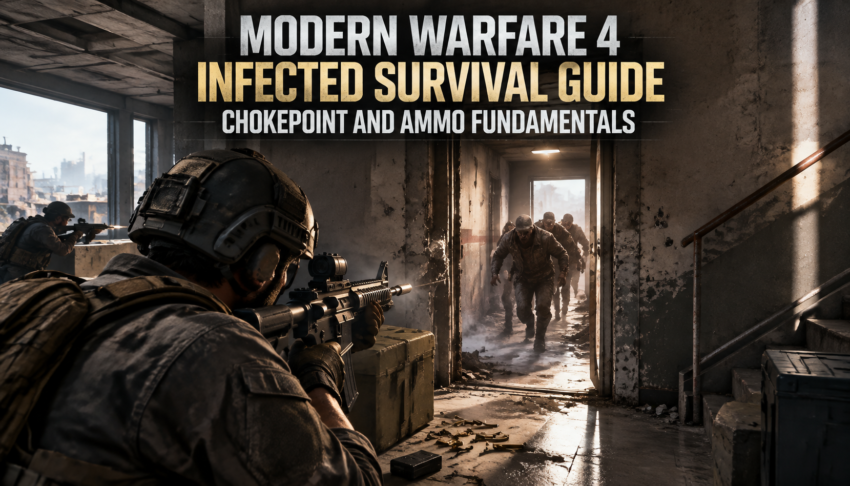
Infected survival is built around a simple trade: every meter of space and every round in the magazine must buy more time. Modern Warfare 4 has not yet established an official Infected ruleset, so there is no confirmed MW4-specific survivor loadout, ammo economy, final-survivor bonus, or equipment pool to optimize around. The useful preparation is therefore mechanical rather than loadout-specific: learn how to reduce exposed angles, control a narrow approach, reload without creating an opening, and rotate before a defensive position collapses.
These fundamentals come from the established structure of Call of Duty’s Infected mode, where eliminated survivors join the attacking side and defensive pressure increases as the survivor group gets smaller. MW4’s confirmed multiplayer systems can help players practice the underlying gunplay and positioning, but they should not be treated as proof of how a future Infected playlist will be configured.
Build Around the Choke, Not the Camping Spot
A strong survival position does not need to be difficult to reach. It needs to make enemy movement predictable.
Doorways, narrow passages, stair entrances, ladders, and other restricted transitions can reduce the number of directions defenders must watch. The useful part is not the choke itself, but the reaction time it creates after an attacker enters the lane.
Before settling into a defensive position, check:
- Approach count: Fewer viable entrances mean fewer simultaneous aim checks.
- Firing depth: Leave space between your weapon and the choke instead of standing directly beside it.
- Visibility: You need enough sightline to identify and engage a threat before it reaches close range.
- Crossfire potential: Teammates should be able to cover separate approaches without stacking into one firing line.
- Fallback space: Avoid a position that becomes impossible to leave after the entrance is breached.
A one-door room can look ideal until attackers cross that doorway. If there is no room to retreat, the same geometry that protected the survivors becomes a trap.
Divide the Hold Into Firing Responsibilities
Survivors waste a strong position when every weapon follows the same target. If several players fire into the primary entrance while nobody watches the flank, the group has traded map control for unnecessary damage concentration.
Instead, split the defense by threat direction.
- Cover the busiest lane with most of the available firepower.
- Keep secondary access points under observation.
- Avoid dumping multiple magazines into a target already controlled by teammates.
- Reassign angles whenever the number of survivors changes.
- Prepare a fallback before the group loses enough players to expose another route.
This setup also improves ammunition efficiency. Predictable targets require less tracking, while clearly divided responsibilities reduce duplicate shooting.
Ammo Discipline Starts With the First Target
Running low on ammunition is usually the end of an earlier chain of mistakes. Excessive bursts, shooting targets already covered by teammates, and firing without a clear target all reduce how long a defensive position can sustain pressure.
Use the choke to make shooting easier. Let attackers enter the predictable lane, confirm the target, then fire only as much as the engagement requires.
Cut These Habits First
- Holding the trigger after the target leaves the sightline
- Firing blindly into an obstructed approach
- Shooting because teammates are shooting rather than because you have a target
- Emptying the magazine during a panic push
- Taking unnecessary fights outside the area your group is controlling
Ammo conservation should not make you passive. The goal is to remove immediate threats with fewer wasted rounds so that enough firepower remains when the attacking side becomes harder to contain.
Reload Windows Matter More Than a Full Magazine
Reloading after every elimination feels safe because it restores the magazine to full capacity. In a repeated-rush mode, however, the reload itself can create the opening that kills the defender.
Check pressure before touching the reload button.
If the lane is clear: reload and reset your aim before the next push.
If a teammate has the lane covered: use that coverage instead of both players reloading together.
If another attacker is already approaching: keep the weapon ready if the remaining ammunition is sufficient.
If the group is under sustained pressure: stagger reloads so at least one weapon continues covering the choke.
This becomes increasingly important as survivors disappear. Losing one active weapon for a reload has a much larger effect when only two or three defenders remain.
Use MW4 Multiplayer to Practice the Transferable Skills
Modern Warfare 4’s confirmed multiplayer sandbox gives players ways to practice movement, lane control, gun handling, target switching, and defensive positioning before any MW4-specific Infected strategy can be established.
For players using Bot Lobby MW4 sessions as a practice environment, the useful goal is not farming easy eliminations. Use low-pressure engagements to work on crosshair placement around narrow entrances, controlled bursts, reload timing, rapid target transitions, and moving from one defensible sightline to another.
A simple practice sequence works well:
- Choose a narrow lane with more than one possible approach nearby.
- Hold far enough behind the entrance to preserve reaction distance.
- Engage only confirmed targets entering your controlled space.
- Check the secondary angle before reloading.
- Reposition once the original lane becomes difficult to control.
- Repeat from a different position instead of memorizing one camping spot.
The purpose is to build habits that remain useful even if a future Infected playlist restricts normal Create-a-Class choices.
Treat Area Denial as Extra Reaction Time
MW4 includes multiplayer tools built around controlling or disrupting movement. Their value in normal multiplayer shows why area denial matters around a choke, but their presence in multiplayer does not mean they will automatically be available in Infected.
That distinction matters when planning ahead. Do not build an Infected strategy around a particular Field Upgrade, lethal, tactical, perk, or attachment until the playlist actually allows it.
If an eventual ruleset provides movement-denial equipment, use the same placement logic as your gun coverage: reinforce the route that is hardest to watch rather than stacking every defensive resource onto the entrance everyone is already aiming at.
The purpose of a delaying tool is often not the elimination itself. For a defender, even a short interruption can create time to finish another target, complete a reload, turn toward a flank, or begin a rotation.
Leave Before the Chokepoint Fully Breaks
A defensive position has failed before enemies physically surround the survivors. The warning signs appear earlier.
Start looking for the exit when:
- Multiple approaches require constant attention.
- Attackers repeatedly reach close range.
- Teammates can no longer cover each other’s reloads.
- The group is losing firing continuity.
- A secondary route can no longer be watched.
- The next rush is likely to enter the defensive space itself.
Leaving immediately after the first sign of pressure wastes a useful position. Waiting until attackers occupy the room removes most of your escape options.
The best rotation window sits between those two points: the hold is becoming unsustainable, but defenders still have enough distance and firepower to disengage.
Change the Plan as the Survivor Group Shrinks
Infected does not stay tactically static. Every converted survivor simultaneously removes defensive firepower and adds another attacker, so the value of a position changes throughout the round.
| Situation | Priority | Avoid |
| Large survivor group | Establish crossfire | Everyone covering one lane |
| Pressure increasing | Preserve ammo | Duplicate shooting |
| Angles becoming exposed | Prepare a rotation | Waiting for the breach |
| Small survivor group | Reduce commitments | Defending too many routes |
| Final survivor | Preserve time and space | Taking every available fight |
This is why a strong early-round position may become a poor late-round position without anything about the map itself changing. The defensive group has changed.
A final survivor also has a different objective from a full defensive stack. Crossfire and staggered reloads are no longer available, so route knowledge, engagement selection, distance, and movement become more important than protecting a static location.
Keep DMZ Progression Separate
MW4’s DMZ is a separate extraction experience built around deployment, objectives, looting, survival, and extraction. That progression loop should not be mixed into multiplayer Infected planning.
For example, CoD MW4 DMZ Items belong to decisions made around the extraction mode and its inventory or progression systems. They should not be presented as Infected resources unless the game later establishes an explicit connection between those modes.
For Infected preparation, keep the focus narrower: improve crosshair placement at chokepoints, stop overlapping unnecessary fire with teammates, reload according to pressure, maintain enough distance to recover from missed shots, and identify an exit before committing to a defensive location. If MW4 later receives Infected, its actual weapon pool, ammunition rules, equipment restrictions, radar behavior, and final-survivor mechanics can then be layered onto those fundamentals without relying on mechanics that have not been confirmed.