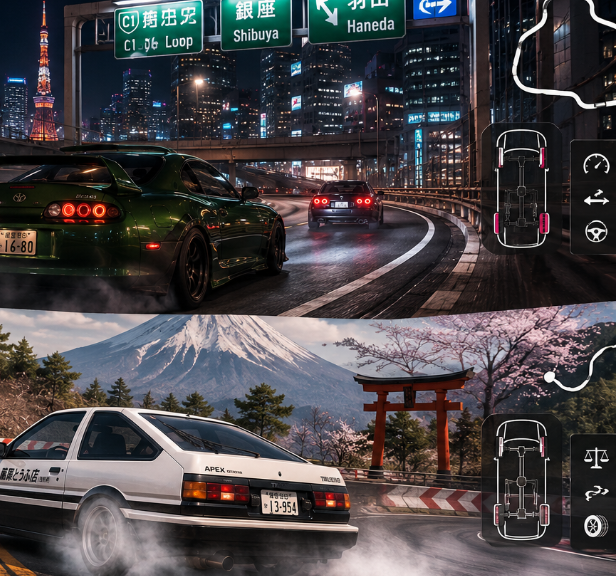
The arrival of Forza Horizon 6 brings players to one of the most highly anticipated settings in racing game history: Japan. From the high-speed expressways of Tokyo to the legendary mountain roads inspired by Mount Haruna, the game offers a completely different driving experience compared to previous entries.
Success on these technical roads requires more than simply choosing a powerful vehicle. Drivers must understand how tuning affects handling, stability, and drift control across different environments.
Best Setup for the Tokyo C1 Loop
The Tokyo C1 Loop is built around high-speed corners, elevated highway ramps, and narrow barriers that leave little room for mistakes. Maintaining speed while transitioning between drifts is essential.
Front Camber Settings
For drift-focused builds, increasing negative front camber improves tire contact during aggressive steering inputs.
Recommended setting:
Front Camber: -3.5°
Rear Camber: -1.5° to -2.0°
This setup improves front-end grip while maintaining predictable rear-end movement.
Rear Anti-Roll Bar Adjustment
A stiffer rear anti-roll bar helps initiate drifts more easily and reduces excessive body roll during quick transitions.
Recommended setting:
Rear Anti-Roll Bar: Higher than stock
Front Anti-Roll Bar: Moderate stiffness
This creates a responsive chassis suitable for the fast directional changes found throughout the C1 Loop.
Front Caster Angle
Increasing caster improves steering self-centering and makes drift transitions smoother.
Recommended setting:
Front Caster: 7.0°
This is particularly useful when linking multiple corners along elevated highway sections.
Mount Haruna Drift Tuning Setup
Unlike Tokyo’s smooth roads, Mount Haruna features steep elevation changes, uneven surfaces, and tight hairpin corners.
A more forgiving suspension setup is often required.
Softer Spring Rates
Reducing spring stiffness allows the chassis to absorb weight transfer more effectively.
Recommended adjustment:
Lower spring rates by approximately 20% compared to highway setups
This improves stability during downhill braking and corner entry.
Tire Pressure Optimization
Proper tire pressure plays a major role in maintaining consistent drift angles.
Recommended settings:
Front Tires: 28 PSI
Rear Tires: 22 PSI
The additional rear grip helps create predictable slides without excessive wheelspin.
Final Drive Ratio
Shorter gearing keeps the engine in its optimal power range during technical mountain sections.
Focus on maintaining engine speed within the strongest part of the power band, particularly during third- and fourth-gear drift sections.
Best Cars for Drifting in Japan
While modern hypercars offer exceptional acceleration, they are often less effective on technical roads where balance and control are more important than raw speed.
Some of the best Forza Horizon 6 Cars for drifting include:
Classic rear-wheel-drive Japanese coupes
Turbocharged inline-six platforms
Lightweight rotary-powered sports cars
Balanced front-engine rear-wheel-drive chassis
These vehicles provide excellent weight distribution and are easier to tune for both highway and mountain drifting.
As players progress through the game, earning additional Forza Horizon 6 Credits becomes important for purchasing upgrades, tuning parts, and expanding a competitive garage. Investing those credits wisely can significantly improve performance and unlock more specialized drift builds.
Mastering the Tokyo C1 Loop and Mount Haruna requires different approaches to vehicle setup. The C1 Loop rewards responsive steering, aggressive drift transitions, and high-speed stability, while Mount Haruna demands smoother suspension tuning and greater control during elevation changes.
By combining the right tuning adjustments with carefully selected Forza Horizon 6 Cars, players can build versatile drift machines capable of dominating both city highways and mountain passes. Continue refining your setup, earn more Forza Horizon 6 Credits, and take on some of the most iconic roads ever featured in a racing game.